Improving the position of Women in the labour markets of peripheral INdustrial regions
Principal Investigator at ZRC SAZU
Asst. Prof. Jani Kozina, PhD-
Original Title
Improving the position of Women in the labour markets of peripheral INdustrial regions
-
Acronym
WIN
Project Team
David Bole, PhD, Maruša Goluža, PhD, Petra Rus, PhD, Primož Gašperič, PhD, Katarina Polajnar Horvat, PhD, Marko Senčar Mrdaković, Asst. Prof. Jani Kozina, PhD-
ARIS Project ID
DRP0200067
-
Duration
1 January 2024–30 June 2026 -
Lead Partner
-
Project Leader
-
Financial Source
Slovenian Research and Innovation Agency

European Regional Development Fund: Interreg Programme Danube Region
Partners
Research Centre of the Slovenian Academy of Sciences and Arts, Association for Culture and Education PiNA , University of Graz, Registered association Styrian Iron Road , LAG Sokolovsko , Central Transdanubian Regional Innovation Agency Nonprofit Ltd., Ministry of Economy Affairs of Hercegbosnian Canton, Employment Office of Herceg-Bosnian Canton , Association of Business Women in Serbia, National Management School
The Danube Region is characterized by pronounced gender inequalities in employment, as female unemployment is higher than male unemployment, particularly in peripheral highly industrialized regions. The economies of these areas are traditionally oriented toward male-dominated industries, which reinforces narrow labour markets and gender stereotypes. The COVID-19 crisis has further exacerbated these disparities. Gender inequality, and the related vulnerability of women in labour markets, therefore remains a persistent problem that no country in the Danube Region has yet effectively addressed.
The overall objective of the WIN project is to improve the position of women workers in peripheral industrial regions, contributing to more accessible, inclusive and effective labour market for them. The project aims to strengthen women’s employment opportunities by removing cultural and institutional barriers and by empowering women to better utilize their professional potential. This will be achieved through a transnational approach that includes an in-depth analysis of challenges, knowledge exchange, and the implementation of pilot actions tailored to regional needs. In addition, the project seeks to strengthen institutional capacities through awareness-raising activities and improved policy design at the local, national, and macro-regional levels.
The main results of the WIN project include jointly developed solutions, pilot measures, action plans, and policy recommendations, supported by a strong transnational network and a joint awareness-raising campaign. The jointly developed solutions refer to a methodological tool for developing social innovations to promote women’s employment, tested in seven pilot areas across Danube Region countries (AT, BIH, BU, CZ, HU, RS and SI). The experiences from the pilot activities will be compiled in a handbook, and the sustainability of the results will be ensured through local and regional action plans as well as tailored policy recommendations, including at the level of the EUSDR.
The WIN project primarily targets women in peripheral industrial towns and regions facing economic decline, outmigration, and limited employment opportunities. In addition to women, it also addresses women’s associations, employers, support organizations, public institutions, academia, and civil society. Through its macro-regional approach, the project bridges the gap between general policies and locally specific challenges, contributing to a more equitable and inclusive development of these areas.
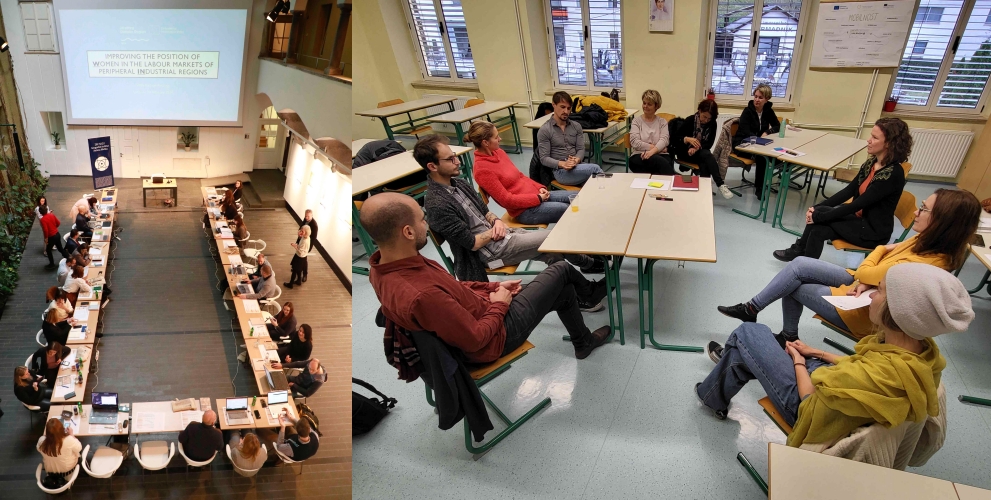
Work package 1: Women’s needs and institutional barriers in labour markets of peripheral industrial regions
The objective of this work package is to deepen the understanding of the challenges faced by women in the labour market of peripheral industrial regions, with a focus on women’s needs and institutional barriers, through transnational situation analysis, networking, and knowledge exchange.
Results:
D.1.1.1 Input paper on the position of women in the labour markets of peripheral industrial regions
D.1.1.2 Comparative study on the position of women in the labour markets of the pilot regions
D.1.3.1 Analysis of local/regional/national employment policies addressing women
D.1.3.2. Peer-review report of local/regional/national employment policies addressing women
D1.3.3: Catalogue of good practises for the employment of women in peripheral industrial settings of the Danube Region
Work package 2: Implementing social innovations to improve the employment of women in peripheral industrial regions
The objective of this work package is to implement seven pilot actions in different peripheral industrial regions of the Danube Region, based on the overarching concept of social innovation. All findings and insights gained during the pilot implementation will be compiled in a handbook on social innovation.
Results:
D.2.1.1 Guidelines for developing social innovations
D.2.1.2 Report on developed social innovations
D.2.2.1 Guidelines for testing social innovations
Work package 3: Strengthening capacities to improve the employment of women in peripheral industrial regions
The objective of this work package is to strengthen public and private institutional capacities for more effective and gender-equal employment of women, raise women’s awareness of career opportunities, implement awareness-raising campaigns at transnational and national levels, and develop regional action plans and policy recommendations to address gender inequalities in the labour market.
AWARDS
In July 2025, the WIN project received international recognition, as it was selected among the “flagship projects of the EU Strategy for the Danube Region.” These are projects or processes that contribute to the implementation of the EU Strategy for the Danube Region (EUSDR), have a clear macro-regional dimension, and apply a multi-level governance approach. They are of great importance for the economic, social, and territorial cohesion of the Danube Region and for improving the quality of life in this region.
-----
Project budget: 1.934.900 EUR
Project budget for ZRC SAZU: 335.500 EUR
Project is co-financed by the European Regional Development Fund in the framework of Interreg Danude Region Programme in amount of 1.547.920 EUR.